


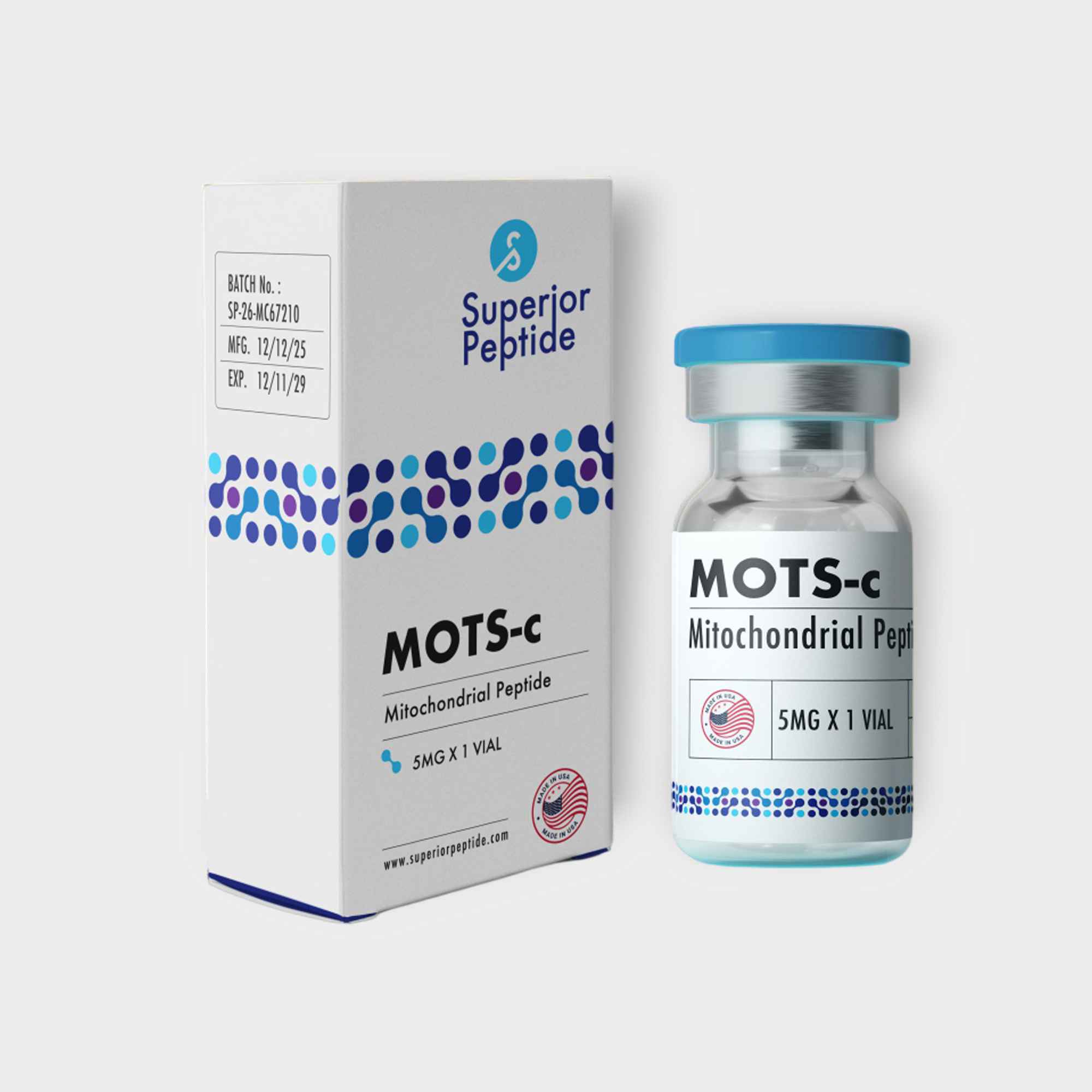

Description
What is MOTS-c?
Superior Peptide MOTS-c is a research peptide derived from mitochondria and composed of 16 amino acids (Met-Arg-Trp-Gln-Glu-Met-Gly-Tyr-Ile-Phe-Tyr-Pro-Arg-Lys-Leu-Arg). Encoded within the mitochondrial 12S rRNA gene, it regulates cellular metabolism through AMPK activation and mitochondrial homeostasis in preclinical studies. MOTS-c is widely used in metabolic and aging research investigating mitochondrial signaling, stress adaptation, and energy regulation mechanisms.
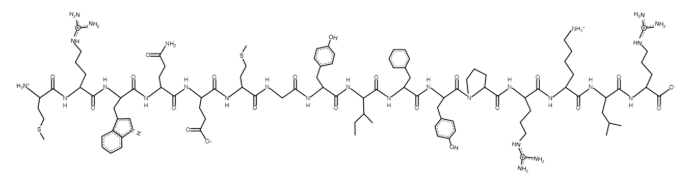
MOTS-c Structure
Sequence: Met-Arg-Trp-Gln-Glu-Met-Gly-Tyr-Ile-Phe-Tyr-Pro-Arg-Lys-Leu-Arg
Molecular Formula: C101H152N28O22S2
Molecular Weight: 2174.64 g/mol
MOTS-c Research
1. Overview
MOTS-c is a short peptide encoded within the mitochondrial genome and has been described in the scientific literature as a member of the mitochondrial-derived peptide (MDP) class. Publications discussing MDPs describe these peptides in the context of mitochondrial signaling and inter-organelle communication within experimental systems. Reports involving MOTS-c describe its identification in cellular compartments including mitochondria and the nucleus under defined experimental conditions. Observations of peptide localization and molecular interactions are limited to non-clinical research settings d are reported as descriptive findings within cellular and animal model studies. All references to MOTS-c are confined to mechanistic and observational research contexts and do not extend beyond laboratory-based investigation.
2. Biochemical Characteristics

MOTS-c Structure, De BQUB17-JHolguera – Trabajo propio, CC BY-SA 4.0
Source: Wikipedia
Sequence: Met-Arg-Trp-GIn-Glu-Met-Gly-Tyr-lle-Phe-Tyr-Pro-Arg-Lys-Leu-Arg
Molecular Formula: C1oH152N280z25z
Molecular Weight: 2174.64 g/mol
PubChem SID: 255386757
CAS Number: 1627580-64-6
Reported Synonyms: Mitochondrial open reading frame of the 12S rRNA-c, MT-RNR1
MOTS-c is a 16-amino acid peptide whose primary structure and molecular composition have been characterized in biochemical research sources. Structural descriptions are limited to physicochemical attributes and reported sequence information derived from non-clinical research references.
3. Research Applications
In the scientific literature, MOTS-c has been referenced in non-clinical research involving cellular assays and animal model studies. These publications describe experimental contexts in which molecular interactions, signaling components, and pathway-associated markers were observed and recorded.
Reported research contexts include examination of:
- Mitochondrial signaling-associated molecular components
- Nuclear translocation phenomena under experimental conditions
- AMPK-associated signaling elements
- Metabolic pathway–related molecular markers
- Gene expression patterns evaluated in cellular and animal models
All reported applications are confined to descriptive investigation within controlled laboratory research environments.
4. Pathway / Mechanistic Context
Mechanistic discussions in preclinical publications describe MOTS-c in relation to intracellular signaling pathways associated with energy-sensing and stress-responsive molecular networks, including components of the AMPK signaling framework.
Additional references describe experimental observations of MOTS-c localization to the nucleus under defined laboratory conditions, alongside reported associations with transcriptional regulation of nuclear-encoded genes. These descriptions are limited to molecular and biochemical observations within experimental systems.
All pathway-related descriptions are restricted to non-clinical research contexts and do not imply functional outcomes.
5. Preclinical Research Summary
Preclinical studies cited in the scientific literature describe observations involving MOTS-c in cellular and animal model systems. Reported observations include measurements of signaling-associated proteins, metabolite profiles, and gene expression markers recorded under defined experimental conditions.
Additional publications describe associations between MOTS-c and molecular features observed in experimental models of metabolic stress and mitochondrial perturbation. All reported findings are restricted to the experimental systems employed.



Reviews
There are no reviews yet.